
Tree Removal in Indianapolis.


How To Choose A Tree Removal Specialist-
There is a huge difference between tree removal professionals and any Joe who claims he can remove a tree. Here are 5 ways to determine an unqualified Joe from a professional:
Choose someone open to showing you their up-to-date COI (Certificate of Insurance).
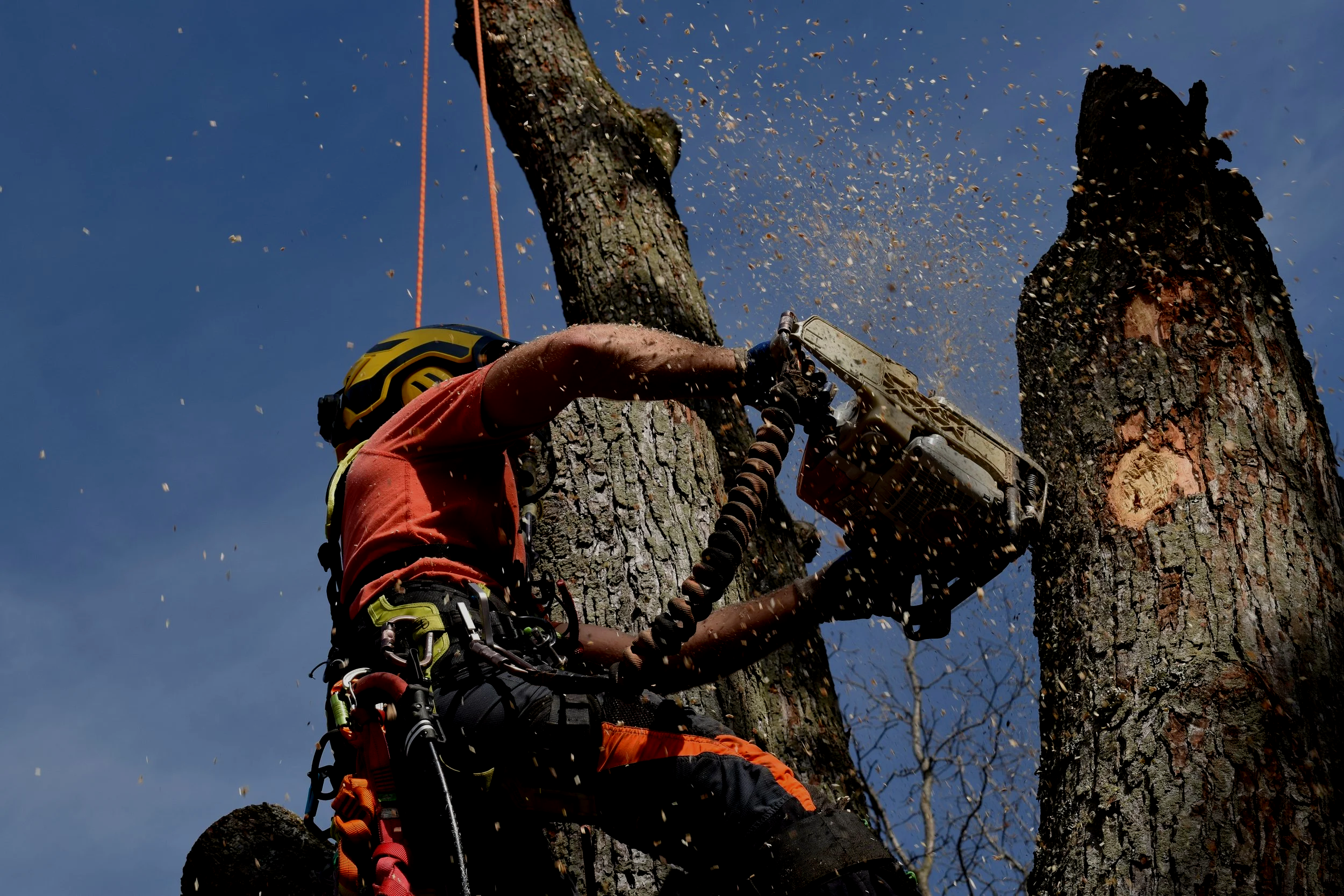
Choose a team that wears essential PPE (like Bluetooth Helmets & Chainsaw Protective Pants).
Choose a company that can tell you the working load limit (WLL) and minimum breaking strength (MBS) of their gear.
Choose someone with a tree risk assessment certification who can explain conditions of concern and give honest recommendations.
Choose a company that can clearly articulate in advance how the job is to be performed.
This list isn’t foolproof, but it’s a great start. Companies who meet these standards are likely taking care of both the little and the big things. Read below for a deeper explanation.
“Tree Removal Specialists” vs “Tree Guys”- Our 5 Tips Explained
1. Choose someone very open to showing you their up-to-date COI (Certificate of Insurance). Asking a company to email you their COI is the simplest and best way to filter out a huge swath of unqualified companies. You’ll be surprised by how often companies dodge or give an excuse when asked for their COI. If you get any hesitance from them at all it’s a BIG red flag. Someone with good insurance has no reason to be concerned about showing you their COI. Skip on the people who aren’t quick to produce it for you. When they send it check the name of the company, the date of the policy and the coverage limits. Dishonest companies will sometimes email someone else’s COI that doesn’t have their own company name on it and count on you not reading it. Others will email you an out of date COI from their past that isn’t currently active. Finally, some will send over an active COI with a minimal amount of coverage that doesn’t meet industry standards or leave you protected. Everything I just mentioned I have seen frequently from clients who have been duped.
For starters, look for general liability insurance of $1,000,000 per occurence and $2,000,000 aggregate (industry standard). The companies you REALLY want to work with, though, will carry more than general liability insurance. It’s a really good sign if a company carries additional worker’s compensation insurance, commercial auto insurance and umbrella insurance. These are the requirements for most municipal and commercial contracts, and any company winning those contracts has at least a few ducks in a row. If they carry worker’s comp then they are expressing that their employees are their most important asset and that they value safety. If they carry commercial auto insurance then they are communicating thoughtful concern for the reality that 10-25% of job hours are spent driving. This indicates a thorough company thinking through every cause for concern. Any arborist who takes this job seriously understands that tree removal has inherent risk. Moreover, dealing with thousands of trees over time multiplies that risk. Finally, even those with the highest standards sometimes encounter the unexpected. Choose the company that does their diligence preparing for the unexpected; it might mean they are also doing everything they can to succeed in what they can control.
2. Choose a team that wears essential PPE (like Bluetooth Helmets and Chainsaw Protective Pants). Many professionals would say that all you need for safe tree removal is eye protection, ear protection, a helmet and chaps. Since most companies don’t even provide these items I would argue this is a great starting point…but it’s only a starting point. Can you imagine climbing a tree every week and calling down “stand clear” before every cut 100 times throughout the day (and waiting to cut until you hear “all clear”) without bluetooth built into your helmet? The reality is that people don’t pursue safety when it’s too difficult, which is why you have to make it easy. Bluetooth microphones in helmets promote regular and clear safety communication. Chainsaw protective pants ensure constant protection when making cuts. The reality is that these are just two small pieces of safety gear, but they are a quick way to gauge how a company values safety. Those who are seriously considering safety can articulate to you the riskiest elements of the job and how they are mitigating those risks. Start out by googling a company and seeing what people are wearing in their photos. Safety conscious companies will have helmets with mics and chainsaw pants (bare minimum). Companies with no observable photos or lack of good safety gear are worth skipping.
3. Choose a company that can tell you the working load limit (WLL) and minimum breaking strength (MBS) of their gear. Asking about the WLL and MBS is a quick way to determine whether a company is using guesswork or getting into details of tree removal. Every single rope, pulley or verified piece of tree gear has a labeled working load limit (WLL) and a minimum breaking strength (MBS). These are calculations that communicate the force which gear can safely handle on a day-to-day basis and a one-time-worst-case scenario. If somebody knows the WLL and MBS of their gear then they are likely taking the physics seriously. Tree removal requires understanding of shock-loading, bending/compression/tensile strength and much more. I have asked climbers “how much do you think that piece weighs” and they have no idea. How can someone safely move forward if they don’t have estimations of weight that dictate their gear choice, position and rigging method? They can’t. The main point here is that tree removal is complex and an unfortunate number of companies are just guessing. If you want someone who isn’t guessing then they should know things like the WLL and MBS.
4. Choose someone with a tree risk assessment certification who can explain conditions of concern and give honest recommendations. Sometimes people want a tree removed so it will stop dropping leaves in the gutter. Others want removal so they can put in a pool. The vast majority, however, are just worried that a tree is going to fall and damage something or hurt someone. It’s a tough position since most people have no way to gauge whether a tree poses much risk to them. Unfortunately, without training and continuing education, a “tree guy” can’t analyze risk either. Tree companies shooting from the hip can’t determine a tree’s risk and generally always recommend removal (more money in their pocket). ISA certification is the best way to quickly filter who in the industry is committed to continuous education and steady improvement. If you want to avoid removing trees unnecessarily (and the probable thousands of dollars of cost to take a tree down) choose a certified arborist in Indianapolis who can make qualified recommendations. Beyond the arborist certification there is a specific “tree risk assessment” certification which provides further specified training. I carry this and recommend it to all arborists. Consider starting your next search with “certified arborist tree service near me” and filter your results from there.
P.S - Workers regularly get new information about the tree when they get aerial; beyond the salesman, the crew needs to be able to assess that new information and combine it with the goals of the client to create the best outcome. The sweet spot is to find a company that prioritizes their production team getting certified, not just their salesmen.
5. Choose a company that can clearly articulate in advance how the job is to be performed. Not every team has the equipment or climbing skills necessary for safe tree removal. More important, not every company has the wisdom to walk away or recommend others when they are not the best for the job. Some trees require a crane. Other trees require a spider lift. Others can only be accessed by a climber. On the flip side, plenty of trees DON’T have a high degree of complexity and you can use a cheaper tree service or an over-qualified team that is humble enough to bid a job at what it is worth. If one company thinks they need a crane and someone else says the tree can be felled, ask them how they determined that. For any tree that Nova Tree Care works on I can tell you tie-in locations, rigging methods, rigging positioning and much more. I can also tell you pretty accurately where the costs of the job come from and how that might compare to someone who has different equipment. Most teams have their specialties and their weak points. Ask lots of questions about how a team intends to do the job, why they think that is best and how they intend to execute. I always give as much detail as possible and pursue honesty with clients when I think another company could perform the work better than us.
If you found any of this helpful please do call us or click the button below for advice on your trees any time. We are very open source with what we know!